Have you ever seen someone earn millions of views on a video and asked yourself what they really earned? Well, you’re definitely not alone. How much does YouTube pay per view is perhaps the most common and most confusing question related to content creation on the platform. But the honest truth is, YouTube pays per view but not in a fixed way.
In fact, the answer to the question how much does YouTube pay may be very vague. But here’s a guide which will answer in detail how much does YouTube pay, the figures, and how to estimate your earnings even before uploading a video.
How YouTube monetization works (the basics)
YouTube is an intermediary between the content producers and advertisers; it does not employ you for viewing.
Does YouTube pay per view?
No, that’s not how it works. YouTube pays creators for a share of the ad revenue from their videos and that revenue depends on the number of ads that have been displayed or even viewed on a channel, rather than just how many views a video has. Thus, two videos with an equal number of views can yield completely different income depending on the viewer’s geographical location, their niche, and whether the video had any ads before or after the playback.
Therefore, when asked how much money do you get per view on YouTube, the truthful answer will be: it’s all about the ad view, not the video view. The view without an ad will yield nothing.
What YouTube actually pays for
When you join the YouTube Partner Program (YPP), there are more ways than just regular display and skippable ads through which you earn money:
Display and video ads - the basic source of most creator earnings;
YouTube Premium revenue share - a percentage from subscriptions earned through the time people spend watching your content using YouTube Premium;
Channel memberships - monthly subscription payments from your fans;
Super Chat and Super Stickers - a form of monetization while you live stream;
Super Thanks - a one-time tip given to your content and Shorts.
All of this together equals the revenue analytics that YouTube shows you, and the reason why two creators with the same amount of views can earn very different amounts of money.
CPM vs RPM
This is by far the most perplexing part of monetizing on YouTube, and that's why it should be cleared up upfront:
Metric | What it means | Who it reflects |
CPM (Cost Per Mille) | What the advertiser pays to YouTube for every thousand ads viewed | The advertiser's spend |
RPM (Revenue Per Mille) | What you actually make on every thousand video views through all your revenue streams | The creator's take-home |
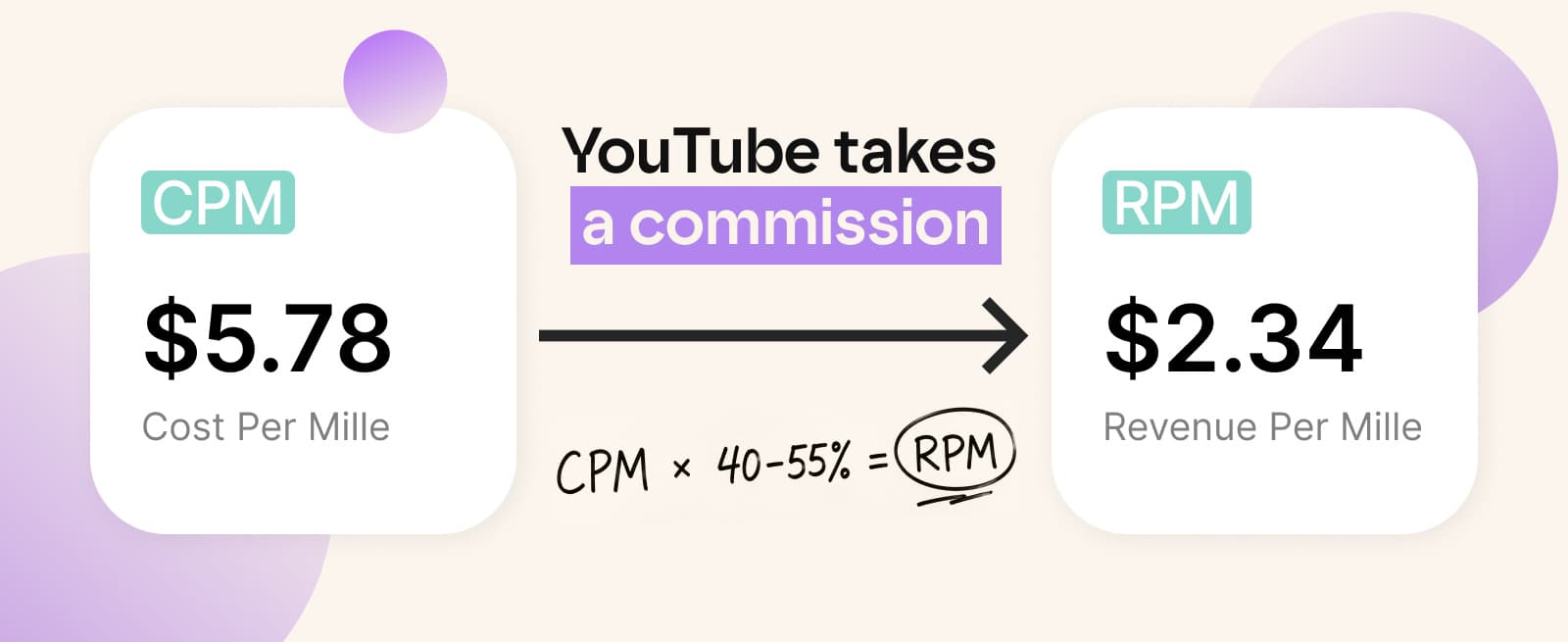
CPM is what you bid as an advertiser while RPM is the actual money that goes into your AdSense account after taking into account the deduction from YouTube and excluding those views with no ads at all. The usual RPM is around 40-55% of the corresponding CPM value. If your niche has $20 CPM, then the RPM may be around $8-$11.
YouTube Partner Program requirements
Before all of this comes to effect for you, your channel must first be part of the YouTube Partner Program. As of 2026, YouTube uses a two-level process. Here’s the YouTube Partner Program overview:
Level one (expanded YouTube Partner Program):
500+ subscribers;
3 public videos posted in the last 90 days;
3,000 hours watched in the last 12 months or 3 million Shorts views in the last 90 days.
Level two (ads, Premium revenues, etc.):
1,000+ subscribers;
4,000 valid hours watched in the last 12 months or 10 million valid Shorts views in the last 90 days;
No active Community Guidelines strikes;
AdSense account set up and two-factor authentication enabled.
Keep in mind that starting February 1, 2027, YouTube is raising these entry thresholds: Level two will require 8,000 watch hours (up from 4,000) or 20 million Shorts views (up from 10 million) in the last 90 days. Read the full upcoming changes to YPP thresholds before planning your monetization timeline. With approval, you get ads on your videos and full access to all monetization options mentioned above.
How much you really earn on YouTube
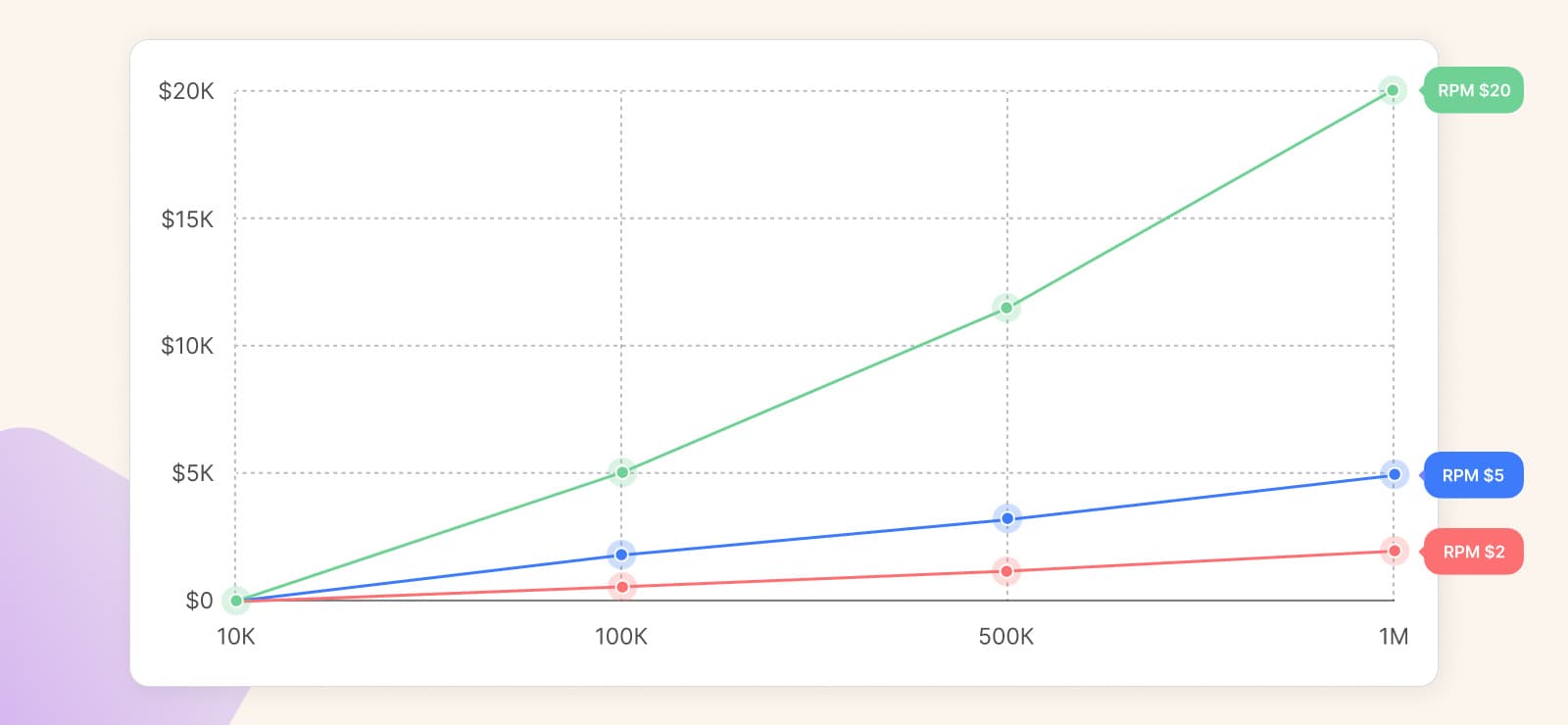
The figures are widely divergent depending on the specific market, geographic location of the audience, and video duration. A financial channel can potentially make 20 times more revenue from one view compared to a gaming channel with similar viewership.
How much YouTube pays per 1,000 views
That’s where you get your definitive answer to how much does YouTube pay per 1000 views. It's quite a broad range with most of the monetized channels earning from $0.50 to $10 RPM with a worldwide average often being cited as $3-$5. But that "average" figure is pretty useless for any kind of planning, since it's an average of $18 RPM channels with financial content and $1 RPM channels of meme or gaming content.
A more practical way of looking at it would be expecting about $2 to $10 per every 1,000 views for a medium-sized channel on a fairly monetizable niche with high CPM niches like finance going well beyond $15.
How much YouTube pays for 100K and 1M views
Scaling your RPM up to a point is just multiplication, as shown below across a realistic range of RPMs.
Views | RPM $2 | RPM $5 | RPM $10 | RPM $20 (finance-tier) |
10,000 | $20 | $50 | $100 | $200 |
100,000 | $200 | $500 | $1,000 | $2,000 |
1,000,000 | $2,000 | $5,000 | $10,000 | $20,000 |
Thus, even for one million views, you may make between $2,000 and $20,000, which is an extremely wide range depending only on your niche and geographic location of the target audience.
How to estimate your own earnings
Channels owners are recommended to get familiar with the YouTube’s official revenue analytics glossary before calculating their income. Then, the best method to forecast your earnings is as follows:
Get your true RPM from your YouTube Studio revenue report (YouTube Studio > Analytics > Revenue) — it's not an estimation, it's your actual number.
Then multiply RPM by your expected views and divide by 1,000.
Take seasonal factors into account (see below) if you are forecasting ahead several months.
If your channel hasn’t been monetized yet, then use the niche benchmarks from further down this article, and then substitute your actual RPM when YouTube assigns one to you.
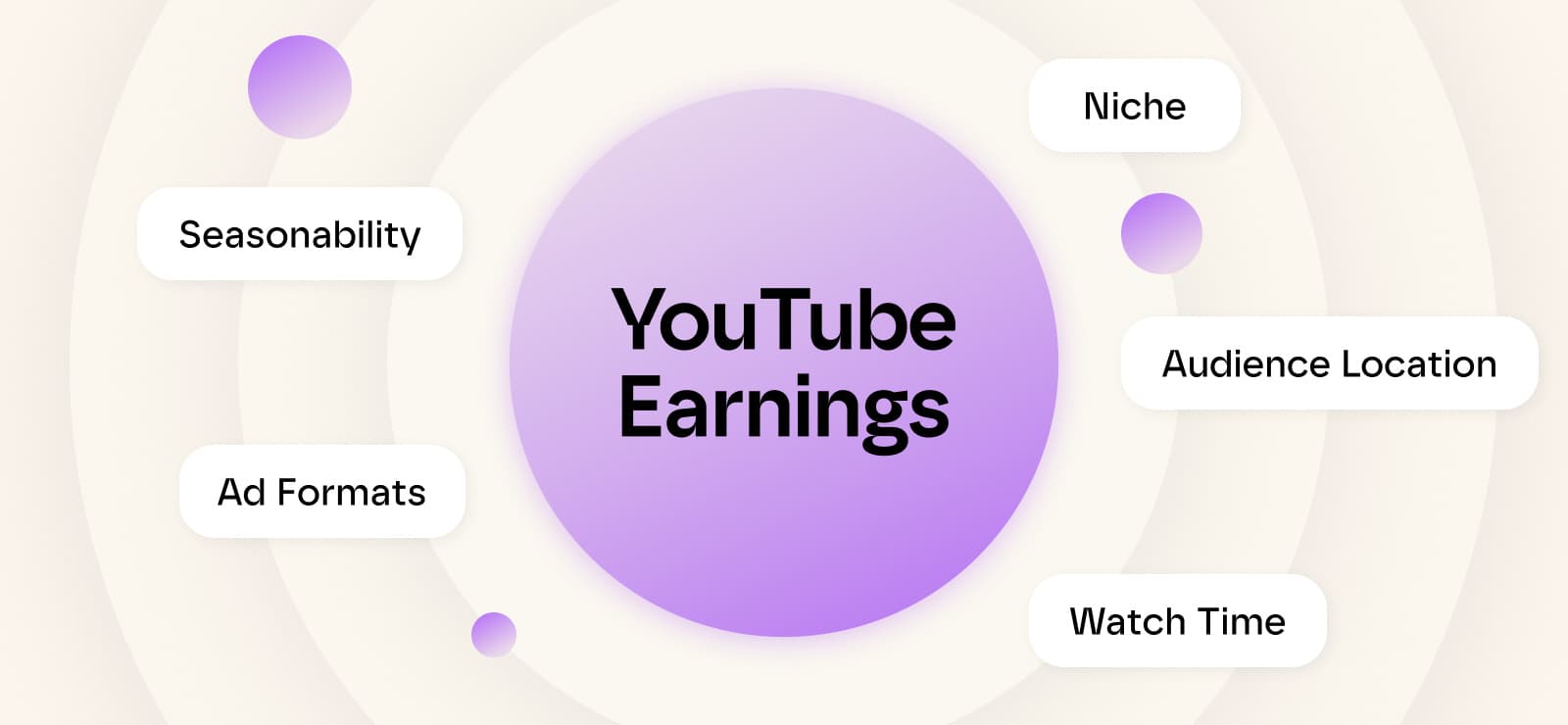
Why creator earnings vary so much
Niche
Certain subject areas just inherently get more interest from advertisers who have more money to spend. Content about finance, software and insurance gets bids from banks and brokers; content about games and comedy gets bids from advertisers in a more competitive, low-CPM pool of advertisers.
Audience location
A creator in finance whose content appeals to users in the US, the UK, Canada and Australia will earn 5 to 15 times more per thousand views than creators whose content appeals to users in much of Asia, Africa and Latin America.
Watch time
Longer, more engaging videos allow for more advertising breaks (mid-roll advertisements are available only for videos above 8 minutes in length) and tell YouTube’s advertisement system that the video is engaging, thus raising RPM.
Skippable in-stream ads, non-skippable ads, display ads, and bumper ads have different payouts. Channels that are eligible for more advertisement types and do not lock monetization due to sensitive content will likely have higher RPMs.
Seasonality
Not all months bring the same budgeting from advertisers. The fourth quarter (especially November and December) is known for its peak in terms of budgets because companies try to advertise their holiday campaigns while January is usually lower, sometimes by 30-50%.
YouTube CPM by content type
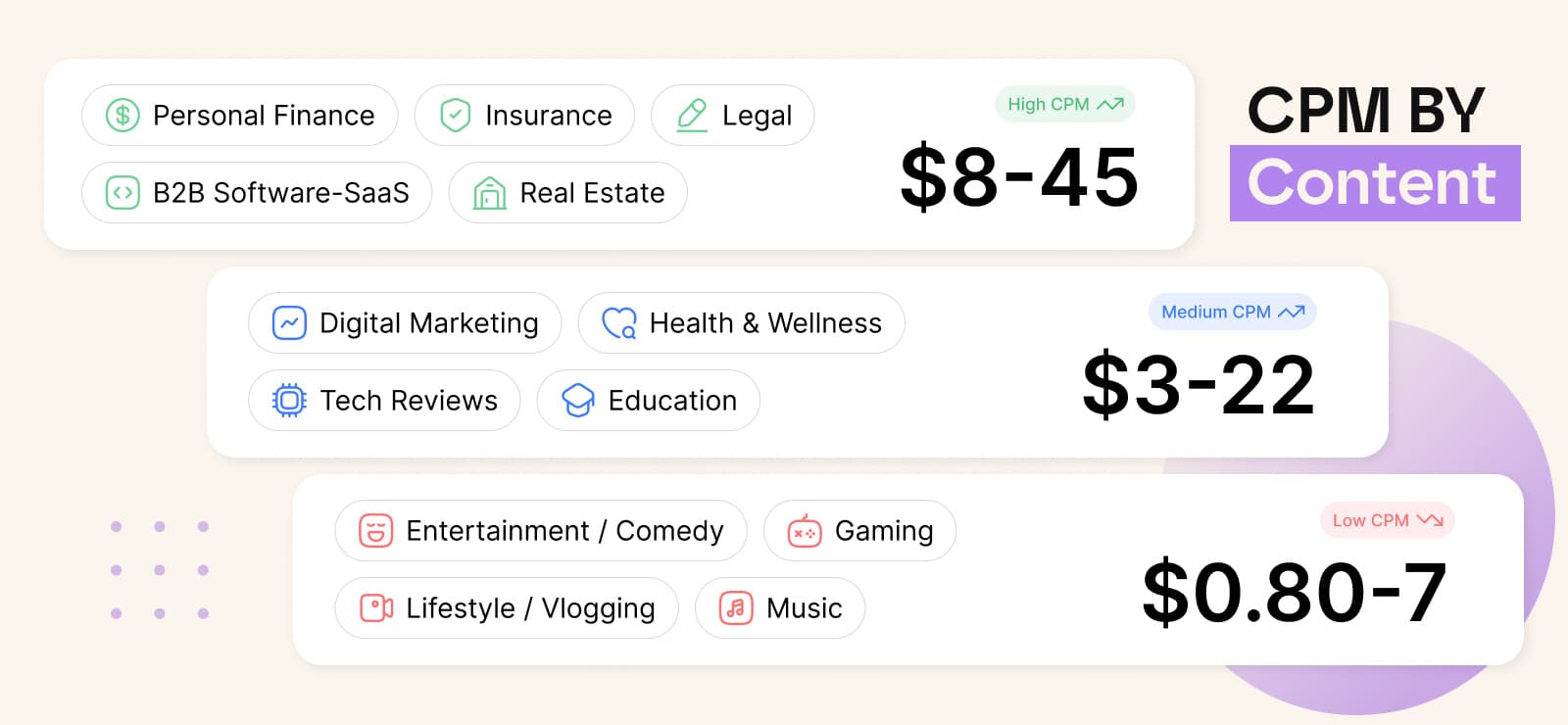
CPM varies enormously by niche, often by a factor of 20 or more between the highest and lowest paying categories.
The figures below are based on industry benchmark data and aggregated CPM estimates from creator analytics platforms, and can vary by campaign, season, and audience geography.
High CPM content
Niche | Typical CPM |
Personal finance / investing | $15-$45 |
Insurance | $15-$32 |
Legal | $12-$28 |
B2B software / SaaS | $10-$24 |
Real estate | $8-$20 |
Medium CPM content
Niche | Typical CPM |
Digital marketing | $8-$22 |
Health and wellness | $5-$16 |
Education | $3-$8 |
Technology reviews | $5-$15 |
Low CPM content
Niche | Typical CPM |
Entertainment / comedy | $1.50-$7 |
Gaming | $1.50-$5.50 |
Lifestyle / vlogging | $1.50-$5.50 |
Music | $0.80-$4 |
The takeaway: a finance YouTube video with 100,000 views can out-earn a gaming YouTube video with a million views, simply because of who's bidding to reach each audience.
How much YouTube shorts pay
The earnings in shorts are entirely different from those in videos. Since there are no ads displayed immediately before or within Shorts videos, the money generated is shared, causing extremely low RPMs compared to long-form videos.
How Shorts monetization works
The YouTube Shorts platform doesn’t have mid-roll or skippable in-stream ads like its long form counterpart. The monetization model on the Shorts platform involves pooling all ad revenue generated from Shorts and sharing it amongst creators in proportion to the number of Shorts views each creator has, and with a portion reserved for the cost of music licensing whenever a creator uploads licensed audio.
Shorts earnings per 1,000 and 1M views
RPM of Shorts is extremely low compared to long form content - $0.03 to $0.10 per 1,000 views, versus $2-$10+ for long form content within the same niche. Here’s what it translates to at scale:
Views | Shorts RPM (~$0.06 avg) |
100,000 | ~$6 |
1,000,000 | ~$60 |
10,000,000 | ~$600 |
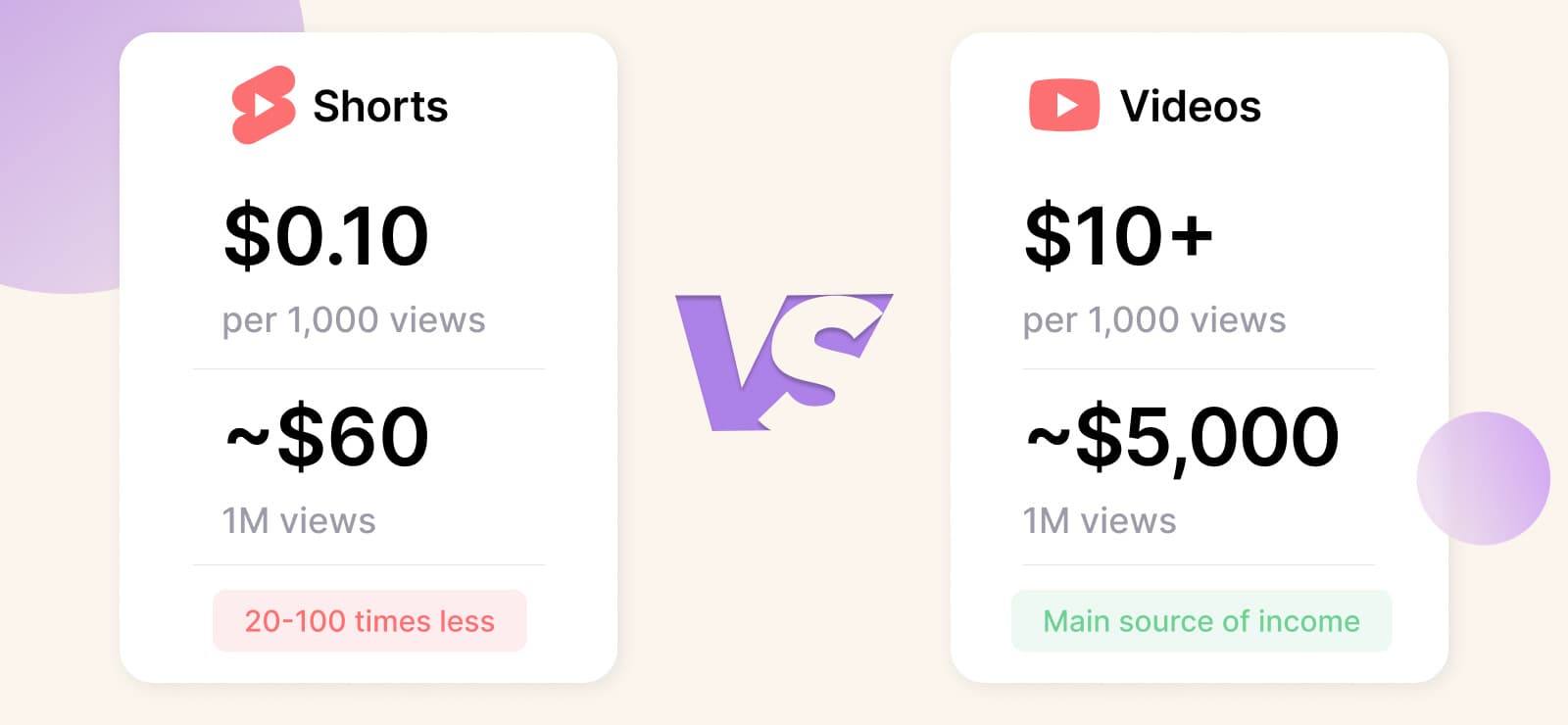
The contrast is obvious: long-form video content and YouTube Shorts can pay different amounts per thousand views. This doesn't mean that Shorts is a bad option, since Shorts tend to be used as a way to build subscribers for long-form videos, where the money is really made. However, it does mean that you need an enormous number of views.
Other ways YouTubers make money
Advertising revenue may only make up a portion of the overall income of a creator, particularly when the channel becomes popular.
There are plenty of YouTube creators who make more money via sponsorships and brands than through AdSense. The pricing for these campaigns is usually structured as flat fees, which could be broken down to an effective CPM (flat fee ÷ number of views × 1,000), with effective CPM rates being well above normal ad CPM rates.
Affiliate marketing
Recommendations of products or software with an affiliate link could bring in big bucks for you in such niches as financial, technology, and SaaS, with a single referral earning you between $50 and $200.
Memberships, merch, and digital products
By offering channel membership, merchandise, and digital goods, creators generate steady streams of non-ad-reliant income.
How to increase your YouTube earnings
Earning more is not only about generating views; it’s about generating the right kinds of views. With the right strategy of selecting your niche, reaching out to the right viewers, and creating videos that convert, you can dramatically increase your RPM.
Choose a high-CPM niche
If your channel is young and you haven’t yet settled down to a vertical, opting for niches such as finance, technology, education, or business-to-business will offer you an inherent earning edge over gaming and entertainment.
Improve retention and watch time
Creating YouTube videos with a focus on retention, frontloading content, and building the structure in such a way that it keeps the viewer engaged beyond 8 minutes (to make mid-roll ads possible) directly impacts your RPM.
Make videos eligible for more ads
Don’t produce videos which get marked as “limited ads.” Excess profanity, controversy, and copyright issues will ensure that fewer advertisers want to bid on your inventory.
Target higher-CPM audiences
YouTube videos with titles, thumbnails, and topics which speak directly to US, UK, Canadian, or Australian audiences will consistently earn more than those made for lower-CPM countries despite having fewer views.
Final thoughts about YouTube earnings
There is no specific formula that answers how much YouTube pays. With the factors of CPM, RPM, niches, location, format, and seasons, two channels earning an equal amount of views can make anywhere from hundreds to tens of thousands of dollars different. The best thing that creators can do is to stop looking for that one universal answer and start monitoring their true RPM via YouTube Studio and work on developing their niche around that. And if you're a brand looking to find and manage creator partnerships, Keppio, an influencer marketing platform, can help you do exactly that.
FAQ
How many views do I need to make $10,000 a month on YouTube?
This is dependent upon your RPM. With a $5 RPM, it would require around 2 million views on YouTube per month. For a $20 RPM (which is usually applicable in the finance niche), it would be about 500,000 views per month. Lower RPM niches such as gaming and entertainment will need many times more.
Do subscribers increase earnings?
No, they won't. The number of subscribers on your YouTube channel has nothing to do with ad revenue. A channel that has 5,000 active subscribers can earn more than a channel with 50,000 inactive followers. The importance of subscribers lies in their ability to generate more consistent viewtime and return visits, indirectly contributing to RPM.
Does watch time affect revenue?
Absolutely. Longer mean view time creates more chances for mid-roll ads and gives better signals to the YouTube ad algorithm, raising RPM.
No. They are not taken into account when paying for a YouTube video. But engagement metrics work as an indicator of your video to recommend it to a larger audience, earning you more money per views, however.